ReferentialGym
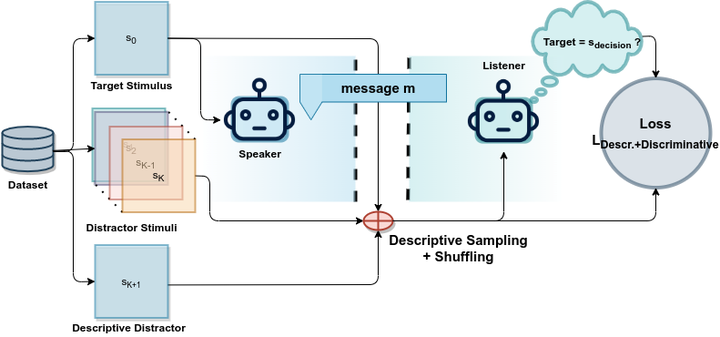 A Referential Game.
This framework provides out-of-the-box implementations of Referential Games variants in order to study the emergence of artificial languages using deep learning, relying on PyTorch. This framework has been in constant development since July 2019. The following paper details its main features:
ReferentialGym: A Nomenclature and Framework for Language Emergence & Grounding in (Visual) Referential Games (or workshop link 2) Kevin Denamganaï and James Alfred Walker. 4th NeurIPS Workshop on Emergent Communication: “Talking with Strangers: Zero-Shot Emergent Communication”, 2020.
Features
- Provides an interface for dataset to be used in the context of referential games.
- Provides state-of-the-art language emergence algorithms based on referential game variants that can be configured at will by the users.
- Provides common implementations of various metrics, e.g. topographic similarity as a compositionality metric, causal influence of communication metric, FactorVAE’s disentanglement metric …
Documentation
Tutorials:
- Getting Started:
 Learn how to use the framework’s features out-of-the-box with different agent architectures and referential game variants.
 - Creating New Modules: Learn how to create new modules either as part of the agents' architecture or as a new metric.
All relevant documentation can be found here and in the above-mentioned paper. Refer to source code for more specific documentation.

Kevin Denamganaï
Independent Researcher
My research investigates the conditions under which AI systems acquire and deploy structured symbolic representations — towards in-context grounding of novel atomic symbols and their systematic recombination into unseen configurations — spanning Compositional Generalisation, Formal Mathematics, Differentiable Language Models, and Physical Simulation. I have also investigated Language Emergence & Grounding (Emergent Communication), Unsupervised Representation Learning, Natural Language Processing, and Multi-Agent Deep Reinforcement Learning.